
The last few years turned out to be hard for many both online and offline stores. Technology is an instrument that can help retailers significantly improve their marketing strategies and ensure a higher revenue. A continuous stream of new, digitally-based technological innovations is every day, conquering the world. This phenomenon is part of the current mega-trend “digitalization”, which has already significantly impacted numerous industries. Concrete examples of two technologies, with are expected to drive major change – thereby offering significant revenue opportunities – in numerous industries in the next few years, are augmented reality (AR) and mixed reality (MR).

Augmented Reality Market Size forecast
AR applications are increasingly accessible via everyday mobile devices and have the potential to make people’s lives easier. Over the last few years, augmented reality has become one of the most valuable marketing tools for numerous companies. This technology is gaining popularity across the globe. The following Statista report shows the global augmented reality (AR) and virtual reality (VR) market is forecast to reach 72.8 billion U.S. dollars in 2024.

Business owners and marketers are leveraging these trends to craft innovative strategies to achieve a competitive edge from enhancing marketing communications and taking customer experience to a new height to increase the efficiency of their business operations.
This perception is likely to have changed with the release of Nintendo’s Pokemon GO smartphone game which was the fastest app in history to reach $ 500 million in revenue and the fastest game to reach $ 1 billion in revenue.

On the other hand, tech giants like Amazon, which uses augmented reality to help customers visualize products in their homes prior to buying them, have widely adopted the technology.
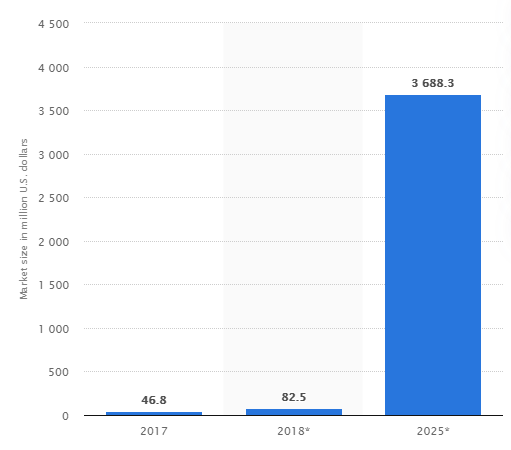
Mixed Reality Market Size forecast
Similar to augmented reality, mixed reality is an overlay of digital content onto the real world. However, what makes mixed reality even more exciting is the fact that content appears in the form of a hologram – that sits within the real world.
Though the idea of mixed reality, which includes virtual and augmented reality, has been around for a long time, it has only recently started picking up speed. Microsoft has already picked up on this idea.
Currently, several hardware companies are developing mixed reality devices that offer a deeper sense of the physical world through enhanced sensors, which provide workers with a 360-degree setting for performing tasks. These sensors are driven by three environment-sensing technologies: infrared technology that maps physical surroundings, infrared technology that captures an employee’s gesture input, and natural language processing for voice recognition. Complicated machine learning and artificial intelligence algorithms piece together data provided through depth sense cameras and configure a virtual world around the worker.
Mixed reality is gaining widespread recognition across business processes, and the momentum is expected to grow further. The following Statista report shows the mixed reality market size worldwide in 2017, 2018, and 2025. It is estimated that over this period the market will increase from roughly 47 million to about 3.7 billion U.S. dollars.
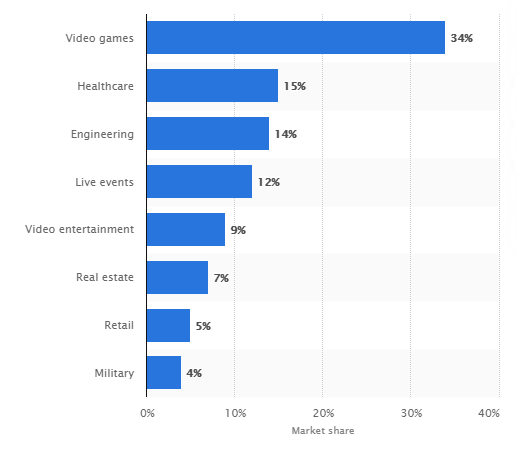
By that time, it is predicted that the video games segment will represent 34 percent of the augmented and mixed reality software market, which is forecast to reach 80 billion U.S. dollars that year.
Conclusion
Only a few of the benefits of implementing augmented and mixed reality technologies:
- Get close to connecting personally with each of your customers. Customers will be able to experience what they are buying into before making a final purchase.
- Reduce call-out times for maintenance. Organizations that used to rely on engineers, working with heavy and often outdated manuals, are now using mixed reality to dramatically cut call out times.
- Speed up the quality control process
- Improve employee training
- Minimize the skilled labor shortage
- It is new and exciting
- In can be used in Content Marketing
- It is engaging
- Stay competitive, innovations offer new opportunities for a vast amount of market for banking & financial firms, healthcare, retail, and even manufacturing.
This means there’s a huge market opportunity for companies in traditionally non-tech-savvy industries. Implementing mixed reality technologies in areas like the entertainment industry has become increasingly common, but by acting now, companies can stay at the cutting edge.
The future is already here, and it is virtual. Reality is right in front of us: Digital transformation is the key to constant innovation and companies all around the globe are aware of the need to leverage digital transformation if they are pursuing to stay one step ahead of their competitors, all that with the help of this technologies.

 Ivana Tilca
Leave a Reply